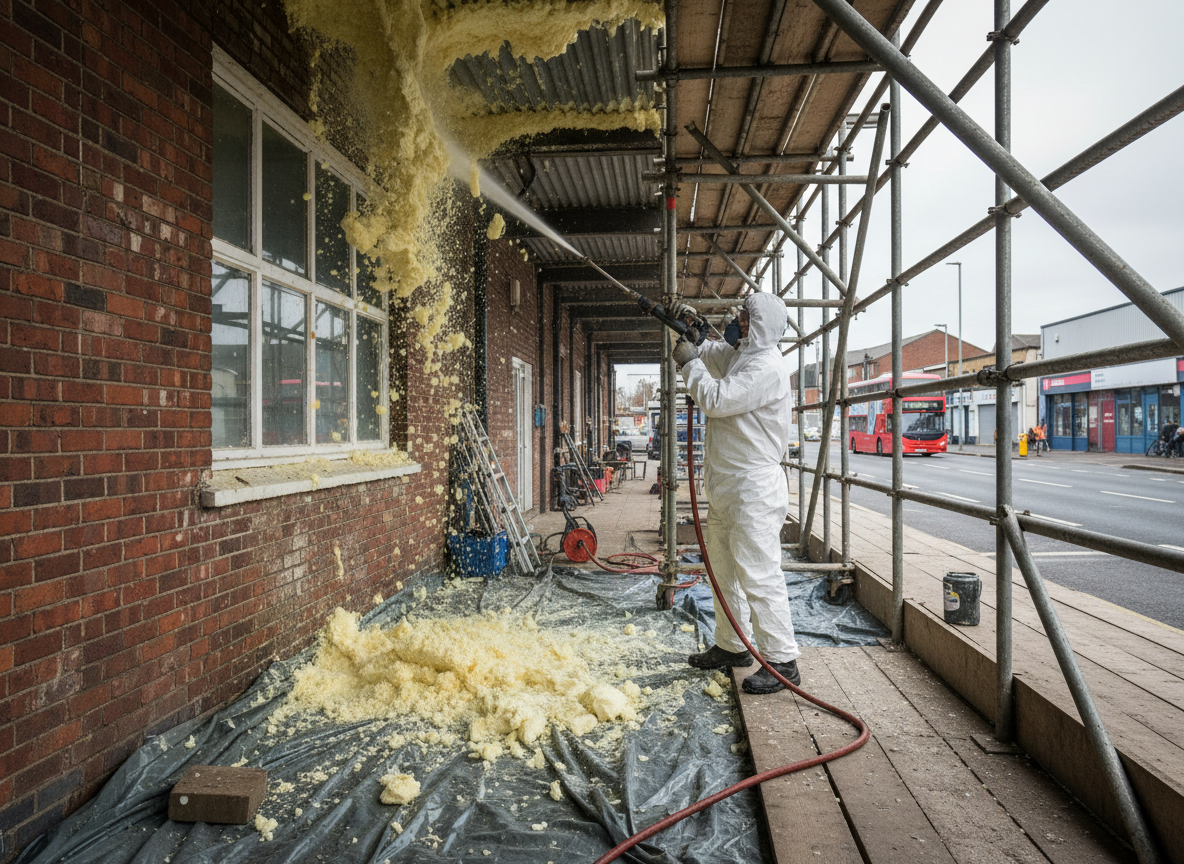
Commercial properties in Croydon often feature spray foam applied to metal deck roofs or concrete soffits in buildings dating from the 1960s through 1980s along routes like Purley Way and the A23 corridor. Over time this foam degrades, traps moisture from the area's frequent winter rainfall, and leads to corrosion or ceiling failure. Removal requires section-by-section cutting, negative-air containment to protect adjacent tenancies, and proper hazardous waste handling under current UK environmental rules.
Access constraints differ markedly between a single-storey warehouse near Waddon and a multi-level office block close to East Croydon station. Scaffolding or cherry-picker work is common, and any disruption to trading hours must be minimised. We coordinate with building managers to isolate zones, maintain fire egress, and schedule noisy extraction outside peak business times while ensuring all removed material leaves site in sealed skips.
Older commercial stock in the Croydon area frequently has foam bridging electrical conduits or HVAC ducts. Cutting through these hidden elements creates both safety risks and potential downtime for tenants. Pre-removal surveys map services with thermal imaging and borescopes so the extraction team can work around live cabling and pipework rather than creating new faults.
Disposal of commercial volumes of spray foam must follow Environment Agency guidelines for construction waste. We separate contaminated and uncontaminated streams on site, issue full waste transfer notes, and leave the building ready for re-insulation or repair by the client's preferred contractor.
Technician insight
In Croydon, the thing that catches most people out with Commercial Spray Foam Removal is how often 1970s warehouse roofs along Purley Way have foam that has wicked into every purlin joint after years of damp winters. You start thinking it's a straightforward strip and end up chasing moisture-damaged insulation into corners that were never visible from the floor.
Warehouse Unit Near Waddon
A logistics unit off the A23 had sagging ceiling panels caused by degraded roof foam. Inspection showed foam bridging several electrical runs. We isolated the affected bay, removed the foam in sealed sections, ventilated the roof void, and left the space clear for the tenant's own re-insulation contractor.
How it works
- 1
Initial Site Survey
Walk the commercial premises to map foam extent, identify services, and note access routes and tenant constraints.
- 2
Containment Setup
Install negative-air machines, dust barriers, and fire-watch protocols to protect occupied areas during extraction.
- 3
Sectional Removal
Cut and bag foam in controlled sections, avoiding damage to decking, conduits, or structural steel.
- 4
Clearance and Documentation
Remove all waste, issue transfer notes, and provide a post-job report for the building manager.
Pricing
Commercial pricing is quoted after a site visit because building size, roof height, and access determine the scope.