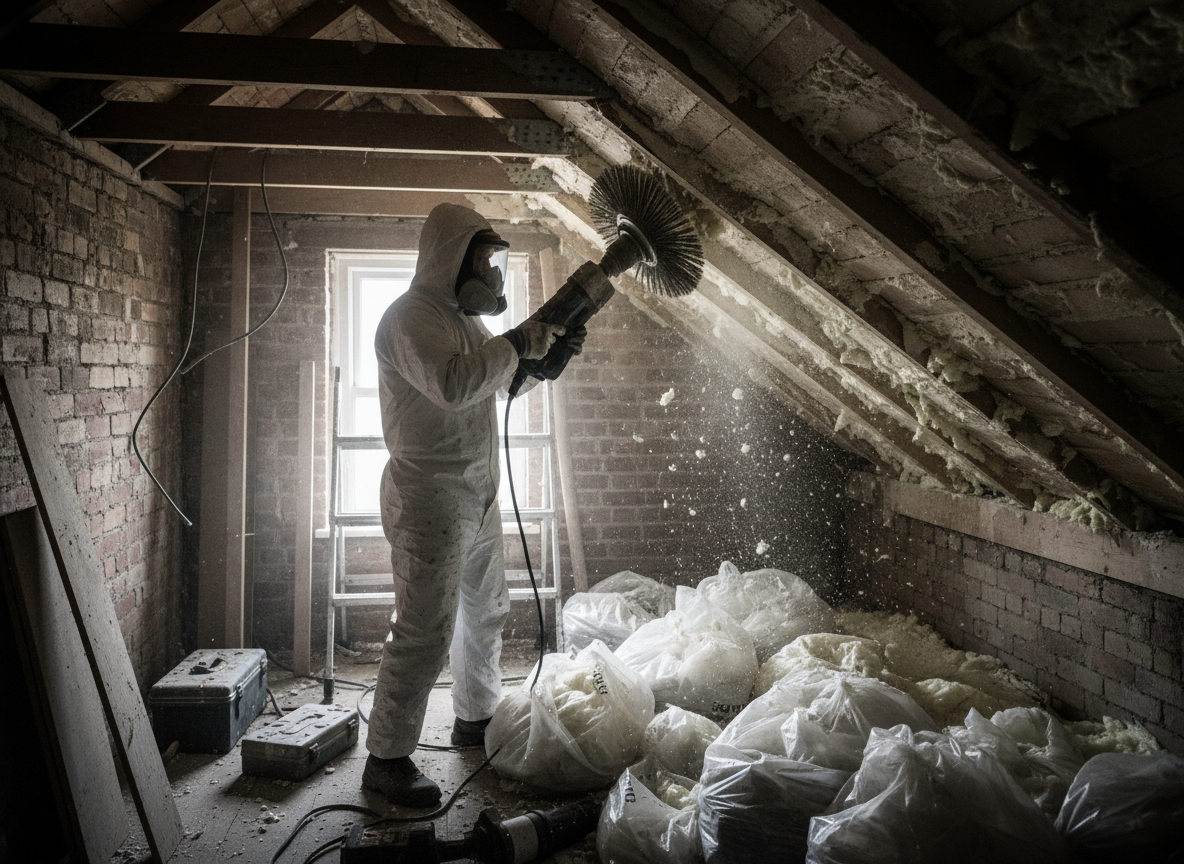
Croydon’s housing stock includes many interwar and post-war terraces and semis around South Croydon and Purley where spray foam was applied directly to roof decks in the 2000s. Once the foam degrades it traps condensation against timber and can block the small eaves vents typical of these roofs, leading to rot in rafters. Removal requires cutting the foam in sections while protecting existing electrical runs and water tanks that sit close to the ceiling in these compact lofts.
Work in the Junction Road area often involves properties with limited loft access via small hatches, so technicians bring sectional staging rather than full boards. The local clay-heavy soil and frequent winter rain mean any roof disturbance must finish the same day to avoid water ingress; temporary breathable membranes are fitted immediately after foam sections are lifted. Waste is bagged on site and taken to licensed disposal points rather than left in skips overnight.
Homeowners in Croydon frequently discover the foam only when selling or after a minor leak, because the material was installed before current building regulations on roof ventilation were tightened. Proper removal restores airflow through the original eaves and ridge vents without disturbing the existing felt or tiles, which are often fragile on 1930s roofs common in the CR2 postcode.
Edge cases include foam that has bonded to lead flashings around chimneys or to older mineral wool in adjacent bays; these sections must be worked by hand to avoid damaging the flashing or creating new gaps. After extraction, a simple smoke test confirms that air now moves freely from eaves to ridge before the job is signed off.
Technician insight
In Croydon the thing that catches most people out with Spray Foam Removal near me is how quickly moisture builds once the foam is disturbed in unventilated 1930s lofts around Junction Road; the clay soil and frequent rain mean you have to finish extraction and restore airflow the same day or risk new damp patches on the ceilings below.
South Croydon terrace loft
Foam applied over the entire roof deck had blocked the small eaves vents, causing visible mould on rafters. We cut and removed the foam in sections while protecting the central water tank and wiring, cleared the original vents, and fitted a temporary membrane. Airflow was restored and the loft dried out within a week.
How it works
- 1
Initial Loft Inspection
Access the roof void through the existing hatch and map foam coverage, noting proximity to cables, tanks and vents.
- 2
Containment Setup
Lay floor protection and seal the hatch area so dust does not enter living spaces below.
- 3
Sectional Foam Removal
Cut and bag foam in manageable pieces, working around services and fragile roof elements.
- 4
Ventilation Restoration
Clear blocked eaves and ridge routes and fit temporary breathable membrane if any felt was disturbed.
- 5
Final Clearance and Disposal
Remove all waste to licensed facilities and carry out a smoke test to confirm restored airflow.
Pricing
Upfront quotes given after inspection; final cost depends on loft access, foam depth and whether additional ventilation work is required.