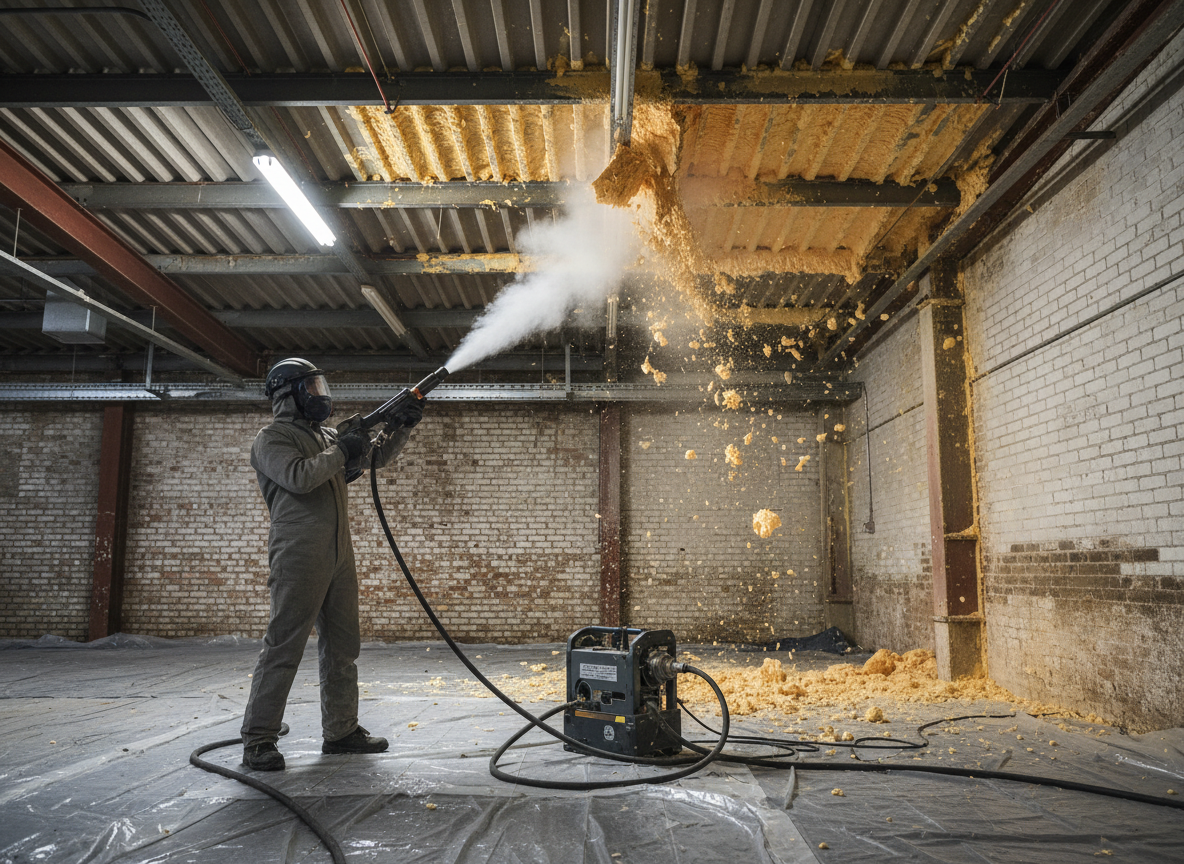
Croydon’s housing stock ranges from late-Victorian terraces in Addiscombe and South Norwood to 1930s semis and 1960s estates around Shirley and Purley. Many of these lofts received closed-cell spray foam in the 2000s, trapping moisture against rafters and causing timber decay. Dry ice blasting removes the foam without solvents or high-pressure water that can drive damp deeper into the original lath and plaster ceilings below.
The process uses solid CO2 pellets accelerated at low temperatures to lift the foam in layers. In Croydon’s mild, wet winters the pellets sublimate quickly, leaving no residue that could combine with the frequent rainfall that soaks through older tiled roofs. Operators must ventilate via existing loft hatches or temporary ducts because the displaced foam dust settles on joists and can migrate into first-floor rooms if not contained.
Edge cases include foam applied over electrical cables and around chimney stacks in pre-1919 terraces. The blasting nozzle is kept at a 45-degree angle to avoid dislodging mortar in brickwork flues. After removal, rafters are inspected for rot; any affected timber is cut out before new insulation is installed. Homeowners along Junction Road often request night or weekend slots because daytime parking restrictions near the station limit van access.
Regulation notes for the Croydon area include checking that removal does not compromise fire separation in converted flats and ensuring waste foam is bagged for licensed disposal rather than left in skips that attract fly-tipping fines.
Technician insight
In Croydon, the thing that catches most people out with dry ice blasting spray foam removal is how often the foam was sprayed right up against the original Victorian ridge board and purlins; once you start blasting you find the timber has already started to rot from the trapped condensation that builds up during our wet winters.
Foam Removal in a 1930s Semi Near Shirley
Homeowner noticed musty smell and ceiling stains after heavy rain. Inspection found closed-cell foam trapping moisture against rafters in a semi off Wickham Road. Dry ice blasting cleared the foam in one day without disturbing the original ceiling; rotted sections of timber were replaced and new ventilation added before re-insulation.
How it works
- 1
Site Assessment
Inspect loft access, foam depth, timber condition and electrical runs in Croydon properties.
- 2
Containment Setup
Seal loft hatches, install dust extraction and protect ceilings below before blasting begins.
- 3
Dry Ice Blasting
Apply CO2 pellets in controlled passes to lift foam without damaging original roof structure.
- 4
Clearance and Inspection
Remove debris, vacuum rafters and check for hidden damp or rot before handover.
Pricing
Upfront quotes based on loft size, foam thickness and access difficulty in Croydon terraces.