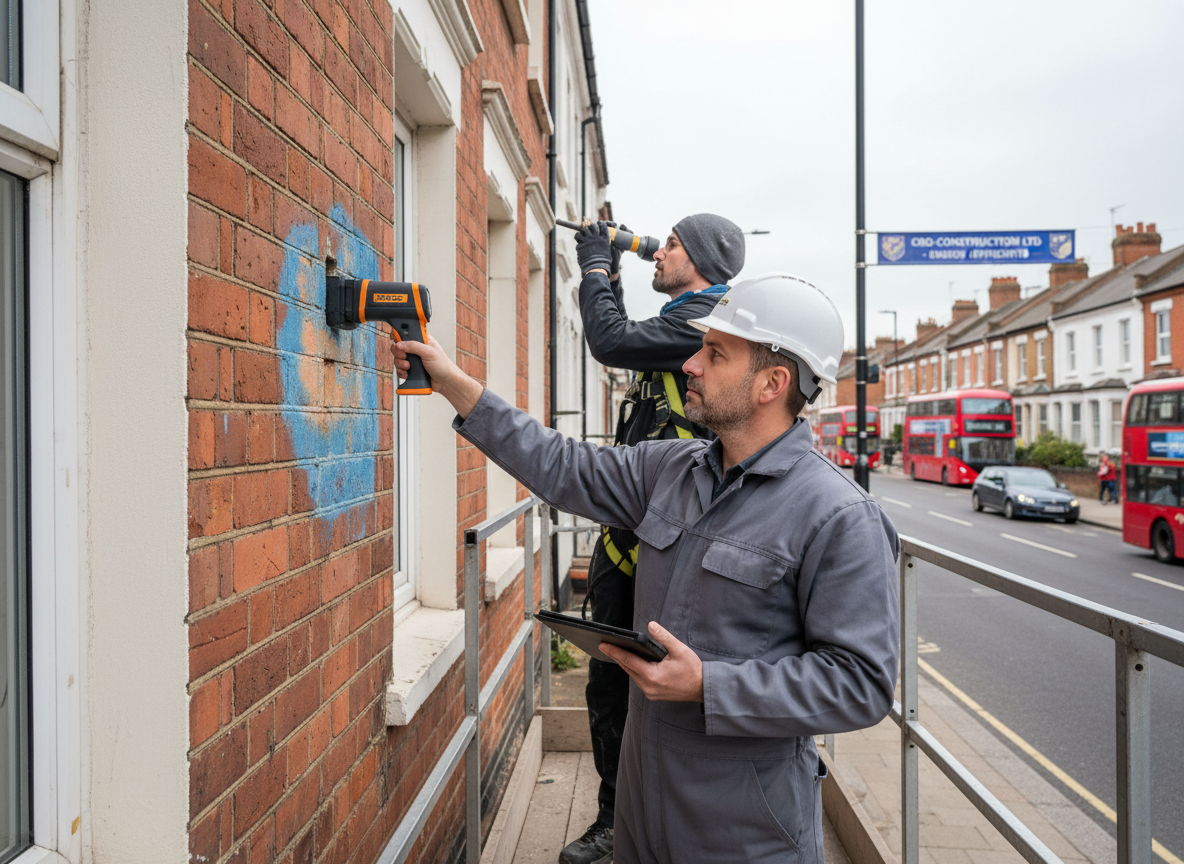
Croydon’s Victorian terraces and 1930s semis around South Croydon and Addiscombe often received spray foam insulation in lofts and under floors during the 2000s. Over time the closed-cell material traps moisture against original timber joists and lathe-and-plaster ceilings, especially where winter rainfall exceeds 600 mm and properties sit on London clay that holds water. An insulation assessment begins with moisture metering at multiple points, borescope inspection through existing vents, and checks for airflow restrictions that the foam itself created.
Assessors look for the tell-tale signs that only appear after several winters: black staining along rafters, raised humidity readings above 70 %, and soft spots in floorboards above ground-floor voids. In properties near the Brighton Road corridor, where many homes still have original chimney breasts, assessors also check whether foam has blocked flue ventilation routes. These findings determine whether removal can be limited to the loft or must extend to floor voids and whether additional timber treatment will be required once the foam is stripped.
Homeowners sometimes assume a quick visual check is enough, yet spray foam hidden behind modern plasterboard in extended kitchens and bathrooms frequently conceals rot that only reveals itself when boards are lifted. The assessment therefore includes targeted removal of small inspection panels and written notes on load-bearing timber condition before any larger works begin.
Why Croydon Homes Need Specific Assessment
Older stock built on clay subsoil moves seasonally; spray foam bonded to moving timbers develops micro-cracks that let condensation reach the wood. Junction Road and nearby roads show repeated cases where foam installed without vapour control layers now requires full extraction plus new breathable insulation.
Technician insight
In Croydon the thing that catches most people out with insulation assessment is the 1930s semis off the Purley Way where spray foam was pumped into floor voids without any thought for the clay soil movement; the boards look fine until you lift them and find the joists already softening.
Hidden Foam in South Croydon Terrace
Homeowner noticed musty smell in the back bedroom after heavy autumn rain. Assessment found closed-cell foam filling the first-floor void and blocking the original air bricks. Small inspection panels revealed surface mould on joists. Foam was mapped for staged removal and the report included ventilation upgrades to restore airflow.
How it works
- 1
Initial Site Walkthrough
Examine loft, floor voids and any recent extensions for visible foam and ventilation paths.
- 2
Moisture and Humidity Mapping
Take readings at joists, wall plates and underfloor areas using calibrated meters.
- 3
Borescope and Panel Inspection
Check behind boards and inside cavities to locate hidden foam and timber condition.
- 4
Written Report and Removal Plan
Provide findings with photos, risk notes and recommended extraction sequence for Croydon properties.
Pricing
Pricing depends on property size, number of voids and extent of hidden foam; quotes are provided after the assessment visit.